Wednesday, 3 February 2016

Brace yourself for alarm testing day

Today, Switzerland will be alive with the sound of more than 8,000 sirens as the country carries out its annual alarm testing.

Siren testing takes place annually on the first Wednesday of February. Two types of devices will be checked this afternoon, starting with the general alarm at 1.30pm, followed in some areas by a water alarm.

Introduced during wartime, they are now used to alert the population to impending catastrophes, including the water alarm for people living in the area below dams.

Testing is carried out by the Federal Civil Protection Office, in coordination with the cantons, communities and dam operators, the aim being to keep these SFr15,000 ($14,200) high tech devices up to scratch.

When hearing a general alarm for real, people should turn on the radio and listen to the official instructions about what they should do to protect themselves and others. On hearing a water alarm, residents should leave the risk area immediately.

France and Austria each have a network and carry out testing. But Germany dismantled much of its system after the end of the Cold War and has left siren usage up to local authorities. Italy no longer has a network.


The sirens form an important part of the country’s civil protection programme, which also includes the provision of underground bunkers – did you know 95 per cent of the population have access to one?

Switzerland gets new 'baby hatch'

Switzerland this week installed its eighth 'baby hatch' - a hole in the wall where mothers are able to anonymously drop off unwanted newborn babies. The latest hatch is located at a hospital in the city of Sion, joining those in Bern, Davos, Olten, Basel, Einsiedeln and Bellinzona.

When an infant is placed into a hatch, the pressure of its body weight activates a heating pad. After three minutes (giving the person time to leave unobserved) an alarm alerts a member of staff who will take care of the child check its health. The baby will then be placed in foster care within a few days.

The mother has 12 months to reclaim the baby if she changes her mind, after which it will be put up for adoption.

The organisation Swiss Aid for Mother and Child (SAMC), a key driver behind the country's baby hatches, says a total of 16 children have been left at the Swiss facilities since the first was opened in Einsiede in 2001.

There are approximately 200 baby hatches across Europe in countries including Austria, Germany, Belgium and Italy. According to UN figures, more than 400 children have been given up in this way since the year 2000.

I can't begin to comprehend the awful circumstances that force a mother to give up her baby but this is amazing – at least she knows that her baby will be looked after and cared for and have the opportunity of a good life. I can imagine these facilities are quite controversial – I know a similar one was rejected in Amsterdam because of protests but it gets a huge thumbs up from me. Well done Switzerland.

Thursday, 28 January 2016

A Great Swiss icon you may not know!

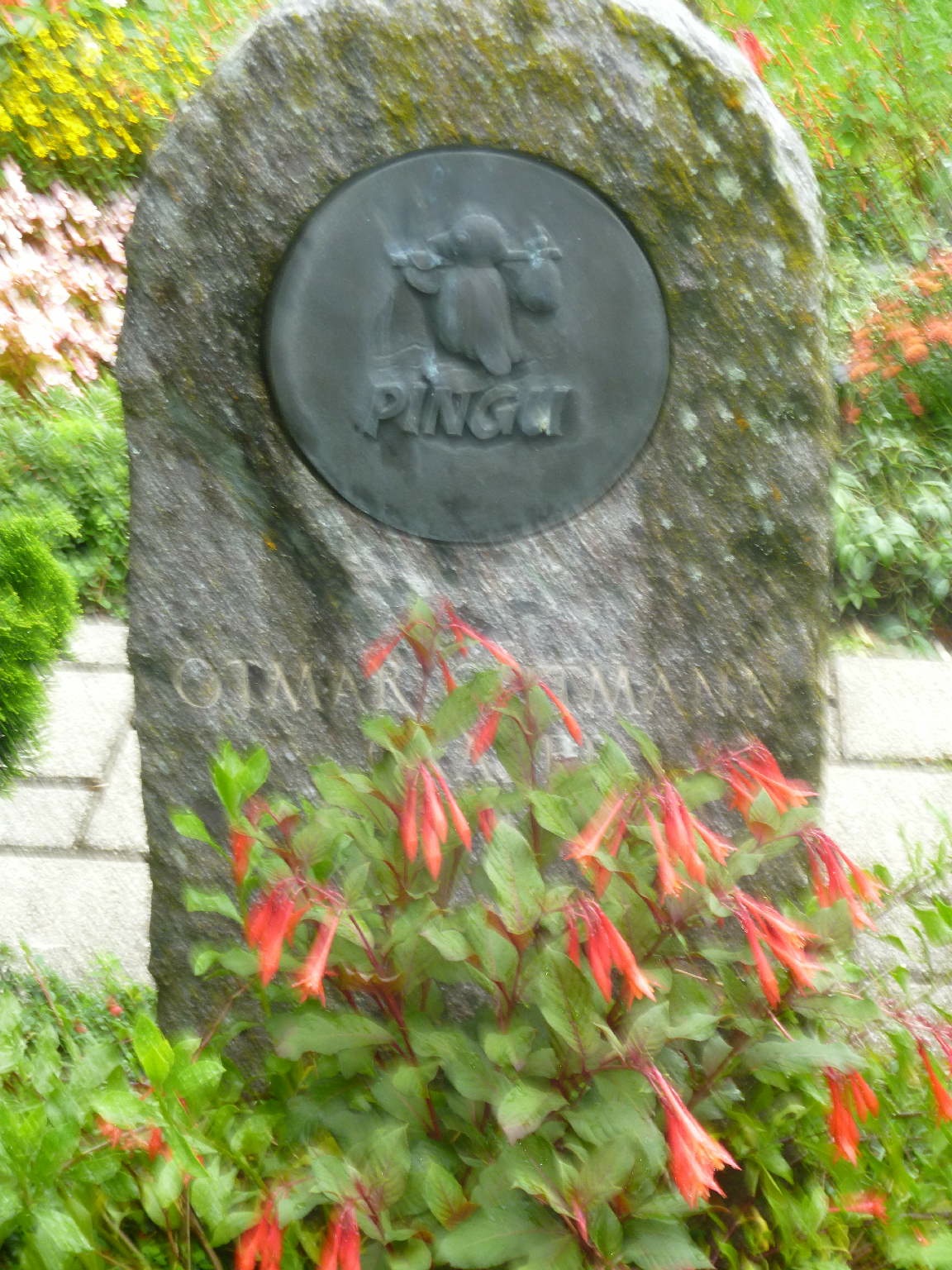
The resting place of Pingu's creator at Russikon Cemetery
Who doesn't know Pingu? But did you know he was Swiss?

Since I found out that Pingu was created down the road in Russikon, I can't shake the feeling that the fact Pingu was born here seems to have been forgotten as the creator sold off all rights to a foreign company just before he died. The only reminder of Pingu's heritage is a little gravestone in the cemetery at Russikon. His studio has been acquired as a residence and there is nothing there to mark the creation of probably the best known penguin in the world.

German born Otmar Gutmann, who died in 1993, first created Pingu at his studio in Russikon, where he brought the pint size penguin to life by creating a different figure for each individual movement sequence, with each scene constructed separately. At the time, the production studio looked as if littered with numerous tiny dolls strewn about haphazardly but the individual elements were gradually pieced together to produce a natural looking scene. Gutmann immersed himself completely in the world of Pingu and as his creation took off, he had to take on a small team to help out.

Pingu was first presented at the Berlin Film Festival in 1987 and soon became a worldwide phenomenon with the simplest of plot lines and an indecipherable language consisting of squeaks and grunts rather than words, which on the DVD and video cases was sometimes dubbed 'Penguinese'. However, owing to the simple plots and descriptive body language, viewers need no dialogue to see what is going on. The family and home focused stories appeal as much to adults as to children.

Gutmann's studio is now a regular Russikon apartment
The first Pingu series was aired on Swiss DRS TV station and soon experienced extraordinary success, eventually being shown on at least 100 different television stations throughout the world. Pingu also went on to win many prizes including the Kleiner Baer at the Berlin Film Festival (1987), the Japanese Maeda award (1991) and the French Prix Jeunesse (1991) To this day, Pingu maintains a cult following and enjoys regular reruns on Cbeebies in the UK. It originally aired on the BBC between 1995 and 2005.

Unfortunately, as far as I can make out Otmar sold all rights to Pingu to a foreign buyer and it seems he didn't make much money from this transaction as I traced the humble life of his wife after his death until she too passed away. It seems very sad.

But you can visit the grave in Russikon and the Gemeinde secretary informs me it is a lovely little visit if you are passing by.

Friday, 22 January 2016

Zurich Zoo - a guaranteed great day out

We love Zurich Zoo.

Not only is it really, really big and open every single day but you get to walk with the penguins! Really! We caught up with the Penguin Parade recently and could not believe it when the penguins began to waddle out of their enclosure and join us on the outside. We then went for a little stroll with – well, behind – them. The quirkest, funniest thing ever. The girls really were gobsmacked.

And for me, this is the most amazing thing about Zurich Zoo – every single time we go, something completely amazing and different happens! There is a goat petting zoo, an elephant enclosure, which is stunning architecturally in the shape of a giant tortoise shell, lots of incredible playgrounds, peacocks wandering around everywhere and so much more - I won't spoil all the surprises.

And we now have annual membership which means we can pop in and out as we please without the stress of having to cover the whole place in a day – which is nigh on impossible when accompanied by little legs. We have single parent membership (hubbie is not keen on the zoo) which costs us 170CHF. For this we get a personalised card (they take a photo there and then) and can avoid the queues – your picture and a welcome message flashes up on the gate as you enter – and can come and go whenever. And we do, sunshine or rain!

Don't delay, visit as soon as you can, this place is brilliant.

Regular annual membership –two parents with children - is 210Sfr

Daily admission is: Adults 26Sfr, Young people 16-24 – 19Sfr, Children 6-15 13 Sfr, Children under 6 go free
Family day pass – 71Sfr

Wednesday, 20 January 2016

Children's books are the way forward

Each week I arrange to meet my daughters in the village library after school and proceed to work my way through a picture book in my quest to learn German. I must look very odd to the locals sitting in the tots corner with an over-sized book on my knee but the librarians are lovely and have even started getting dual German/English language books in for me!

And - brace yourselves - I've now worked my way up to the more sophisticated picture book which features three of four sentences on each page - wowee (although I still need to refer to my Google Translate app constantly) And as I work my way through each book I make a note of certain words and phrases in my German vocab list on my iPhone, to go over whenever I have a minute.

And it occurred to me on my last visit that this would be a helpful feature for visitors to my blog. So I have now included this in the right hand column, featuring the book in question. Do let me know if you find this helpful or a complete waste of time.

This week featured a lovely little story about a mole who found an icicle which he thought was a magic diamond. His friends put him right but then the final glittery illustration shows he was right after all. Nature really is magical and beautiful!

Happy reading!

Useful words and phrases this week:

Eine dicke Schneedecke - a blanket of snow
Baumstamm - tree trunk
Wie wäre es mit einere Schneeball schlact? - how about a snowball fight?
Schau mal nach oben - look up!
Eiszapfen - icicle
Prachtvoll war das - magnificent!
Zauberhaft - enchanting

Tuesday, 19 January 2016

Swiss Dada artist is the only woman featured on a Swiss bank note

 So here’s a bit of Swiss trivia every expat should know – there is only one woman featured on the current set of Swiss bank notes. And that is Sophie Taeuber Arp – featured on the 50CHF note - one of the foremost figures of the rebellious Dada art movement in the early 20th century.

She is featured on today’s Google Doodle in the style of her geometric artwork to celebrate what would have been her 127th birthday.

Born in Davos, Switzerland in 1889, she was one of the founders of the Dada art movement which began after World War One as a reaction to the millions that died as a result of the war. Dadism used materials in an abstract way, often forming experimental composition using geometric shapes.

Sophie’s skills covered painting, designing, weaving, puppetry and dancing. She fought for her style of art to be considered as fine art, and as a result became one of the 20th Century’s most prominent female artists, bridging the gap between fine and applied arts.

Sophie began her art studies in Switzerland at the School of applied Arts in St Gallen between 1906 and 1910, before moving to Munich, Germany to the workshop of Wilhelm von Debschits where she spent a year at the School of Arts and Crafts in Hamburg. She then attended the Laban School of Dance in Zurich in 1916 and spent that summer at the artist colony of Monte Verita in Ascona.

After marrying Jean Arp in 1922, who she met at an art exhibition at the Tanner Gallery, the pair created abstract work together.

Sophie’s day job was then teaching embroidery and weaving at the School of Applied Arts in Zurich, and by night she went in disguise to Dada soirées to protect her identity and teaching job.

The pair moved to France in 1926 where she exhibited her work, but later escaped Nazi occupation and returned to Zurich in 1942. She died a year later after carbon monoxide poisoning from a faulty stove.

Wednesday, 9 December 2015

Share a little of that Christmas excess with those in need

For many people, Christmas is a time of excess, with sumptuous food and lots of presents. Others have very little, even at Christmas. But here in Switzerland you can help!

The 19th ‘2 x Christmas’ campaign starts on Thursday 24 December 2015 and will run until Saturday 9 January 2016. The basic idea behind the campaign is to share a bit of this excess with others.

If you would like to get involved and help to make someone in need especially happy this holiday season you have two possibilities. You can buy a parcel online or put together your own parcel and drop it off at any Post Office near to you. The Post transports the parcels to the Swiss Red Cross free of charge and volunteers sort the contents.

Half of the donations will then be distributed through cantonal Red Cross associations to social institutions and people in need across Switzerland. The rest of the goods will be transported to Eastern Europe: mainly Armenia, Belarus and Bosnia and Herzegovina as well as Moldova. The local Red Cross societies are ensuring the correct distribution to the people in need which are mostly elderly, families with many children or social institutions.

Things to put in your parcel:
  • Non-perishable foodstuffs such as pasta, rice, oil and tinned goods with a shelf life of at least six months
  • Toiletries such as soap, shampoo and toothpaste
  • School equipment such as stationery, crayons and exercise books for children
  • New children's shoes
There is no need for special packaging. An old card board box that closes well is sufficient. Please don't donate any clothes because they are already provided via old clothes collections, and sorting them generates a lot of additional effort. Cuddly toys are also not needed.

Take your parcel to the nearest post office between 24 December 2015 and 9 January 2016, free of charge. The Post offices have printed address labels ready. All you have to say is say ‘2 x Christmas’.